Log On, Tune In, Tour Out: How Discord Servers Became the New Record Labels for Experimental Music
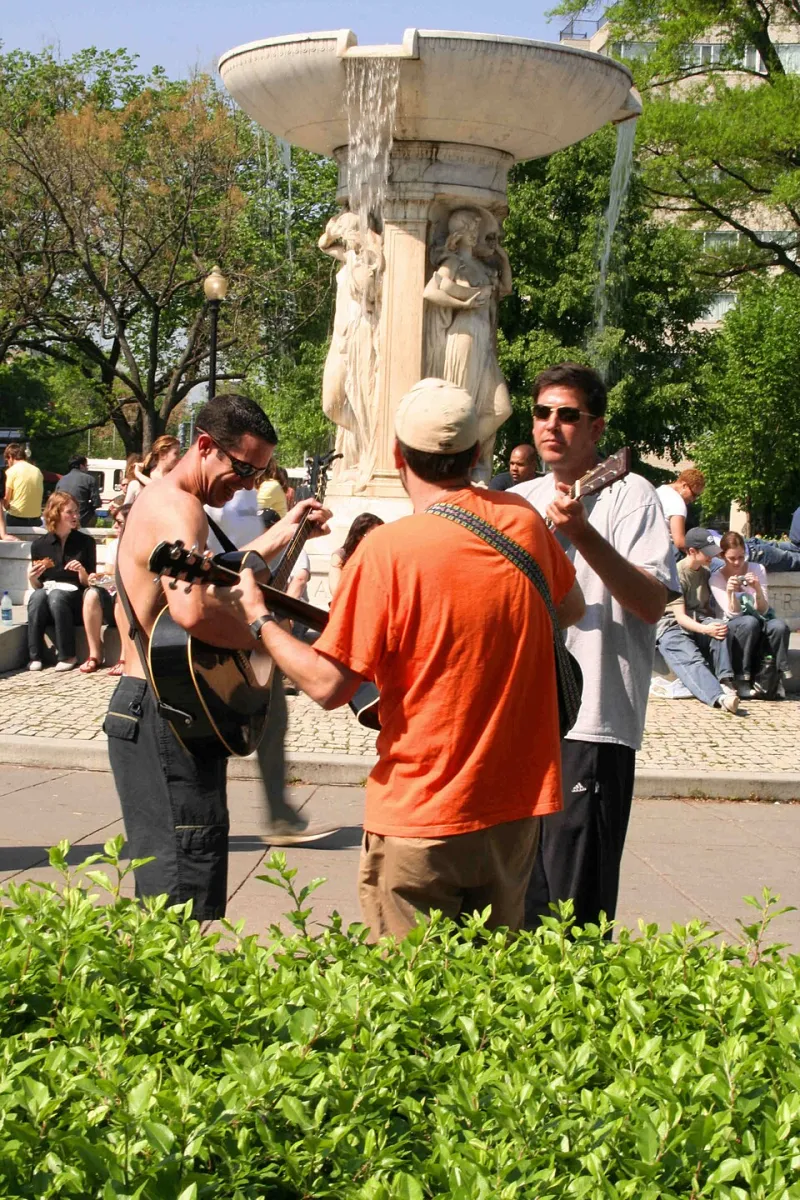
Photo: Elvert Barnes, CC BY 2.0, via Wikimedia Commons
Somewhere in a Discord server with maybe 4,000 members, a producer from Columbus, Ohio just dropped a collaborative EP that took six months and twelve contributors from five different states to make. They've never all been in the same room. Two of them haven't even been on a voice call. But the project has already racked up 30,000 streams in its first week, landed the group a slot at an independent festival in Austin, and generated enough merch revenue to fund the next release.
This isn't an anomaly. This is Tuesday, in 2024, for a growing corner of the experimental and dissonant music world.
The Infrastructure That Wasn't Supposed to Exist
For most of recorded music history, breaking through as an artist in a genuinely niche genre — and dissonant, experimental music is about as niche as it gets — required either a label willing to take a financial risk, or a city scene dense enough to generate word of mouth organically. Neither of those options was particularly accessible.
What nobody predicted was that the internet would eventually produce something that functions almost exactly like a local scene, except the geography is optional.
Discord, which started as a platform for gamers, has quietly become one of the most important organizational tools for underground music communities in the US. Servers dedicated to experimental, noise, avant-garde, and dissonant music have evolved from simple fan chat rooms into something significantly more complex: collaborative production hubs, micro-label operations, tour coordination networks, and in some cases, functioning artist collectives with their own brand identities.
Reddit has played a parallel role, particularly through subreddits like r/experimentalmusic and r/noisemusic, where discovery and community conversation have created pipelines that move artists from total obscurity to dedicated cult followings with a speed that still surprises people who've been watching it happen.
Talking to the People Building This
We reached out to several artists and community organizers who've navigated this space firsthand. What came back wasn't a single unified story — it was a collection of overlapping experiences that, taken together, paint a pretty clear picture of how this ecosystem actually functions.
Marcela V., who runs a Discord community called Fractured Signal out of Chicago, describes the server's evolution as something she genuinely didn't plan. "It started as a place for me and like fifteen friends to share music we were making," she says. "Now it's got almost 6,000 members and we've put out eight releases under the community's name. We have a Bandcamp, we have a merch store, we have a booking channel where people coordinate shows. I didn't build a label — but I kind of accidentally built a label."
That accidental infrastructure is a recurring theme. Community leaders in this space tend to be artists first, organizers second, and they often describe building out the operational side of things in direct response to what their communities needed. When people started asking how to play shows together, someone built a touring coordination channel. When collaborative albums became popular, someone figured out how to handle revenue splits through Bandcamp's payment tools. The institution grew to fit the activity.
Jordan T., a producer from Portland who's released music through three different Discord-adjacent micro-labels, puts it bluntly: "These communities do everything a label does except take your masters and charge you for marketing you didn't want. The tradeoff is you have to actually participate. You can't just drop music and disappear."
The Collaborative Album as Community Event
One of the most distinctive products of this ecosystem is the community collaborative album — a format that barely existed a decade ago and is now genuinely common in experimental online music spaces.
The mechanics vary, but the basic structure is consistent: a server or subreddit announces a compilation or collaborative project, sets parameters (sometimes a theme, sometimes a key or mode, sometimes just a file format requirement), collects contributions from members, and releases the finished product under a collective name. Revenue, when there is any, gets split according to agreed-upon formulas.
What makes these projects interesting isn't just the logistics — it's what they produce artistically. When you have contributors from different cities, different technical backgrounds, and different influences all working within the same constraints, you get records that sound like nothing any individual would have made alone. For experimental and dissonant music specifically, that collision of sensibilities often produces genuinely surprising results.
Marcela points to a compilation her server released last year that featured 22 tracks from 19 contributors. "Three of those artists have since played festivals. Two of them got picked up by small labels that found them through the comp. The project worked as a discovery engine in a way that none of us really anticipated."
Grassroots Tours and the Couch Network
The live component of this ecosystem is maybe the most impressive part, because live music has always been where the rubber meets the road for artists who want sustainable careers.
What's emerged in several cities — Chicago, Portland, Philadelphia, Austin, and parts of the Pacific Northwest in particular — is something people in these communities informally call the "couch network" or the "house show pipeline." Artists connected through online communities coordinate regional tours through direct messages, crashing at each other's places, booking house shows and DIY venue slots in cities where they have community connections.
It's not glamorous. But it works. And critically, it works for music that would never get booked by a traditional club promoter who's optimizing for safe commercial appeal.
"I did a twelve-date tour last spring that I organized entirely through Discord and Reddit DMs," says Jordan. "Every show was either a house show or a small DIY space. I covered my gas, made a little money on merch, and played to audiences that actually knew what they were walking into. That's not nothing. That's actually pretty great."
What This Means for the Broader Music Industry
The major label system has always struggled with genuinely experimental music. The economics don't favor it — niche audiences, long development timelines, and limited radio crossover potential make it a hard sell to anyone optimizing for mass market returns.
What these online communities have demonstrated is that the economics of niche music look completely different when you strip out the overhead of traditional industry infrastructure. A micro-label operating out of a Discord server doesn't have an office, doesn't have a staff of A&R executives, doesn't have a marketing department running six-figure campaigns. It has a Bandcamp page, a motivated community, and artists who are willing to do the work of building an audience one genuine connection at a time.
That's not a replacement for the traditional music industry — it's a parallel track that was never supposed to exist, built by people who needed it to exist and figured out how to make it happen anyway.
For experimental and dissonant music specifically, that parallel track might be the most important development in the genre's history. The music that makes people uncomfortable, that refuses to resolve, that challenges listeners rather than comforting them — it finally has an infrastructure that was designed for it, rather than one it had to awkwardly borrow from genres with completely different needs.
Log on. Tune in. The scene is already there.