Same Notes, Infinite Worlds: How Every Genre Hears the Locrian Mode Differently
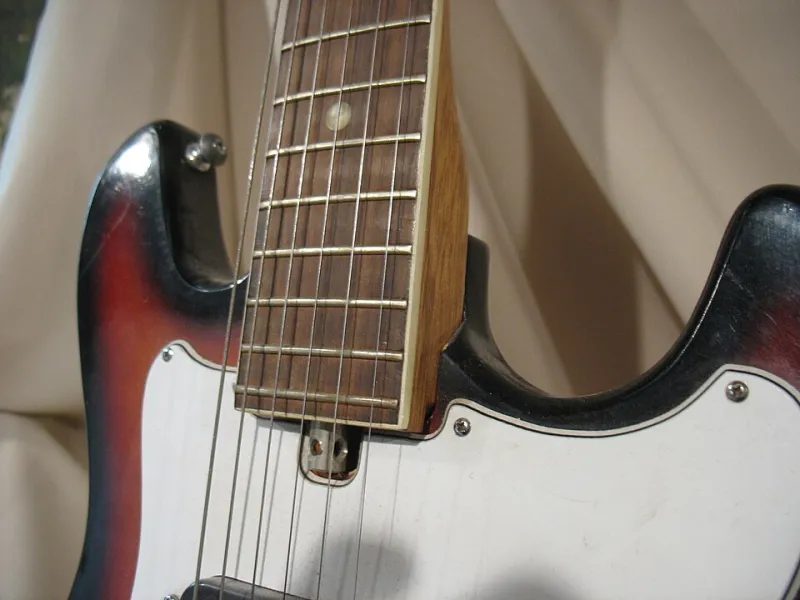
Photo: ΜΕΤΑΠΑΡΡΗΣΙΑΣΤΗΣ, CC BY-SA 4.0, via Wikimedia Commons
There's a persistent myth floating around music theory circles — and honestly, even around casual listener conversations — that the Locrian mode is basically a sonic villain. Dark, unstable, unresolvable. Something composers reached for when they wanted to signal dread. And sure, there's a kernel of truth buried in there. But calling Locrian evil is a little like calling a kitchen knife dangerous: technically possible, wildly reductive, and missing the whole point of what the thing actually does.
Here at Locrian, we've built our identity around the idea that dissonance is a creative tool, not a flaw. So let's actually dig into the mode itself — not as an abstract theory concept, but as a living, breathing musical ingredient that sounds radically different depending on who's cooking with it.
A Quick Primer Before We Go Genre-Hopping
For anyone who skipped music theory class (no judgment), the Locrian mode is the seventh mode of the major scale. If you play a C major scale but start and end on B, you're in B Locrian. What makes it unusual — and what gives it that famously tense quality — is the diminished fifth between the root and the fifth degree. In most scales, that fifth is your anchor. It's stable, it's home. In Locrian, it's flattened, which means the whole tonal center feels like it's balancing on one leg.
Classical composers largely avoided it for this reason. But avoidance isn't the same as irrelevance. And over the last several decades, genre after genre has figured out how to turn that instability into something genuinely interesting.
Metal: Embracing the Chaos Head-On
If any genre was going to welcome Locrian with open arms, it was metal. Specifically, the more technically-oriented corners of the genre — death metal, progressive metal, djent — where musicians have been treating dissonance as a feature since the late '80s.
Bands like Meshuggah and later Periphery built entire compositional philosophies around intervals that refuse to sit still. In a metal context, Locrian's diminished fifth isn't unsettling — it's aggressive. The lack of resolution becomes a kind of relentless forward momentum. You're not waiting for the tension to release; you're living inside it, and that's where the energy lives.
What's interesting here is that metal tends to lean into the physical dimension of Locrian. The low-tuned guitars, the percussive attack, the sheer volume — all of that transforms what might feel like academic dissonance into something visceral. The mode stops being a theory concept and starts being a full-body experience.
Jazz Fusion: Using Instability as Sophistication
Flip the coin completely and you get jazz fusion, where Locrian shows up in a totally different costume. Fusion players — think Allan Holdsworth, or the more adventurous work coming out of the late-'70s Weather Report era — approached modal playing as a way to create harmonic ambiguity rather than aggression.
In a jazz context, Locrian's unresolved quality reads less as threatening and more as sophisticated. When a guitarist or keyboardist slides into Locrian over an altered dominant chord, the dissonance creates this sense of suspended sophistication — like the music is asking a question it's in no hurry to answer. It's cerebral in a way that metal typically isn't, and it appeals to an entirely different kind of listener.
The mode also functions differently in improvisation. Where a metal riff might use Locrian in a locked, repeated pattern that amplifies its tension, a jazz soloist might pass through Locrian briefly, using it as a color inside a longer melodic phrase. It's less a destination and more a texture.
Progressive Rock: Storytelling Through Discomfort
Prog rock sits somewhere between those two poles, and it's maybe the genre that gets the most narrative mileage out of Locrian. Bands like Tool — and earlier, King Crimson — understood that dissonance could function dramatically, the way a film score uses tension to signal that something's about to shift.
In a prog context, Locrian often appears at structural turning points. It's the musical equivalent of a scene change, or a plot twist. The listener doesn't necessarily identify the mode by name, but they feel the ground shift under them. And then when the music moves back toward something more stable, the contrast makes that resolution hit harder than it ever could have without the tension preceding it.
That's actually one of the most underappreciated things about Locrian in prog: it makes other parts of the music feel more powerful by comparison. Darkness, used intentionally, creates the conditions for light to land.
Experimental Electronic Music: Deconstruction as Art Form
And then there's experimental electronic, where the conversation about Locrian gets genuinely weird — in the best possible way.
Producers working in spaces adjacent to noise, glitch, and ambient music often don't approach the Locrian mode as a scale at all. They approach it as a set of relationships — intervals that can be stretched, warped, granularly synthesized, pitched up or down until they're barely recognizable as musical in the traditional sense. Artists like Arca or the broader PC Music-adjacent experimental scene have created work where the concept of Locrian — unresolved, unstable, refusing to land — becomes an organizing aesthetic principle rather than a technical choice.
Here, the mode transcends genre entirely. It stops being about notes on a fretboard and starts being about a philosophy of sound: what happens when music refuses to give you the comfort of resolution? What does that refusal communicate? In experimental electronic music, those questions are often the whole point.
What All of This Actually Tells Us
The Locrian mode doesn't have a fixed emotional meaning. It has a fixed mathematical structure — those intervals don't change — but meaning is something listeners and musicians construct together, and that construction looks completely different depending on context.
Metal hears power. Jazz hears sophistication. Prog hears narrative tension. Experimental music hears a conceptual framework. Same intervals, four completely different emotional worlds.
That's not a paradox. That's what music actually does. And it's why the "Locrian equals dark" shorthand has always been too small a box for what the mode can actually hold. The instability at its core isn't a bug — it's an invitation. Every genre that's taken that invitation seriously has found something worth saying inside it.
We named this site after the mode for a reason. Dissonance isn't a destination. It's a starting point.